AI Should Guide Contractors, Not Replace Their Judgment
Why polished AI output is not enough, and why contractors need context, guidance, and control.

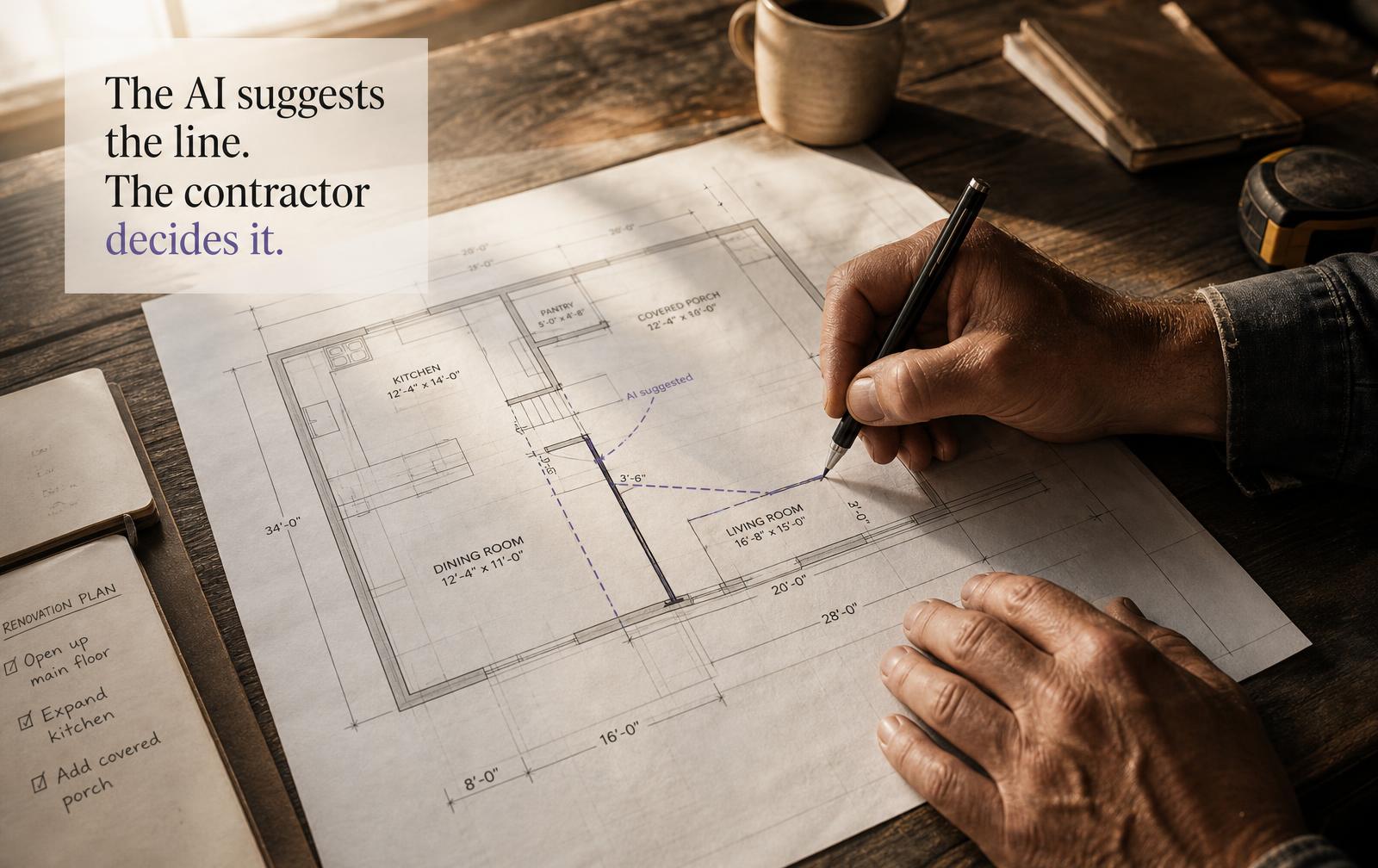
AI should surface information, explain what shaped an answer, and help you refine it with your own business context. It should not hand you polished output as a substitute for your own judgment.
AI can generate an impressive estimate, proposal, or recommendation in seconds. But contractors still need to understand where the answer came from, what assumptions shaped it, and how to apply their own business knowledge before making a decision.
AI can produce an impressive answer in seconds
It can turn project documents into a polished summary, generate an estimate, draft a proposal, or recommend a next step. The output may look complete, professional, and confident.
But polished does not always mean correct.
The real challenge is not getting AI to produce an answer. The challenge is understanding that answer well enough to decide whether it makes sense for your business.
Contractors already have the intelligence
A contractor brings knowledge that an AI system cannot automatically understand.
You know which crews are available. You know which suppliers are dependable. You know when a project description leaves out important work. You know which customers are likely to request several revisions. You know when a seemingly profitable opportunity may become difficult to deliver.
That experience is not something AI should attempt to replace. AI should lean on it.
The best use of AI is not allowing it to make decisions independently. It is using AI to surface information, identify patterns, and help you examine a decision more clearly.
The contractor should remain the person in control.
A beautiful answer can still leave you lost
Many AI tools are designed to generate polished outputs. You give the system a document or a prompt, and it returns something that looks finished. The language is clear. The formatting is professional. The recommendation sounds convincing.
But what happens when something does not look right?
You may see a price and wonder where it came from. You may notice that the proposed scope does not match how your company performs the work. You may question whether a cost reflects your own rates, information from the project documents, or an assumption made by the system.
Without guidance, refining the answer becomes difficult. You are left trying to reverse-engineer the AI's thinking. Instead of helping you make a better decision, the tool gives you another output that you must investigate on your own.
That is where confidence can become dangerous. An AI system may present uncertain information with the same polish as information supported by strong evidence.
Contractors need more than an answer. They need a way to understand, challenge, and improve it.
Guidance is more valuable than automation alone
There is a real difference between AI that simply generates and AI that guides.
- Returns a finished-looking answer
- Hides where the number came from
- Shows uncertainty with the same polish as evidence
- Leaves you reverse-engineering its thinking
- Asks you to trust the output
- Surfaces what it found, and where
- Names the assumptions it made
- Flags what is missing or uncertain
- Points to what you should review
- Adjusts to your rates, history, and judgment
Good AI should help answer questions like these:
The questions good AI should help you answer.
- What information did the system find?Found
- Where did it come from?Source
- What assumptions were made?Assumed
- What is missing or uncertain?Uncertain
- What should you review?Review
- How do we adjust it to your experience?Your context
Guidance gives the contractor a starting point without pretending that the starting point is the final decision.
For example, an AI-generated estimate should not only present a total. It should help the contractor understand the quantities, rates, scope, assumptions, and business context behind that total. The contractor can then decide whether the output reflects the actual project and the way their company operates.
Your business context should shape the final answer
Two contractors can review the same opportunity and reach different conclusions. One company may have a crew available and experience with that exact type of work. Another may need to hire additional labor, use unfamiliar suppliers, or take on more delivery risk.
The documents may be the same, but the business context is not. That is why AI cannot be treated as the final authority.
A useful system should allow contractors to bring their own knowledge into the decision:
The context that turns information into a decision.
AI can organize the information and highlight what deserves attention. The contractor supplies the context that turns the information into a responsible decision.
How Footing approaches AI guidance
Footing is designed to put AI in the contractor's hands, not place the contractor under the AI's control.
Instead of only producing a polished estimate or proposal, Footing helps contractors understand what has been surfaced and what still requires their judgment. The goal is to help contractors see the difference between information found in project documents, information informed by their company's own knowledge, and areas where an assumption or review may be needed.
From there, the contractor can refine the result, add business context, explain their rationale, and decide what should move forward.
Footing does not assume that the AI knows your business better than you do.
It helps you use AI to examine opportunities, build estimates, prepare proposals, and make decisions with greater clarity.
The future of contractor AI is collaborative
The most valuable AI systems will not be the ones that attempt to remove people from the process. They will be the ones that make human judgment easier to apply.
For contractors, this means moving beyond tools that simply produce attractive documents. It means using AI that helps explain the work, surfaces uncertainty, and creates space for the contractor's experience.
- AI can help you move faster.
- AI can notice what you might have missed.
- AI can organize complex information.
But the final decision is yours.
Your intelligence, experience, and business judgment should shape the final decision. That is not a limitation of AI. It is how AI becomes genuinely useful.
Anita Njoku builds AI-native products that turn fragmented operational systems into trusted decision intelligence. Her work focuses on making uncertainty visible, preserving human judgment, and helping teams make better calls with the information they already have. Footing is her first product under ARAUÁN, built to help contractors find solid ground before the bid.
Want AI that shows its work?
Join early access to Footing.
Footing is opening with contractors who want source-backed estimates, clearer bid intelligence, and firmer footing before the proposal goes out — so every bid leaves you on better ground than the last.